

The short answer
Pool cue tip hardness changes how the hit feels and sounds, how fast the tip loses its shape, and how much grooming it needs. It does not change how much spin you get. Testing summarized by Dr. Dave Alciatore found no difference in spin between soft and hard tips at the same tip offset and cue ball speed, and no difference in miscue limit when both are chalked and kept in shape.
So choose by feel and upkeep. Soft tips feel cushioned and need more shaping. Hard tips feel crisp, last longer and hold their shape, but need good chalk. Medium is the usual place to start. Layered leather tips tend to play more consistently than solid ones, and tip size and crown shape matter as much as hardness.
What does pool cue tip hardness actually change?
Hardness is about how much the leather gives when it meets the ball. A softer tip compresses more, so it touches the cue ball over a slightly larger patch and for a slightly longer time. Both tips are on the ball for roughly a thousandth of a second, so that extra contact time does not buy extra spin.
What you notice at the table is feel and sound. A soft tip sends less shock into your grip hand and lands with more of a thud. A hard tip feels and sounds crisper. The bigger practical difference shows up over months: hard tips generally last longer and hold their shape, while soft tips flatten, mushroom and need regular shaping.
| Hardness | Feel and sound | Shape and upkeep | Worth trying if |
|---|---|---|---|
| Soft | Cushioned, quiet thud | Compresses most; mushrooms and flattens sooner; shape often | You like a muted hit and don’t mind grooming |
| Medium | Balanced | Moderate shaping | You are unsure; the common starting point |
| Hard | Crisp, louder | Holds shape longer; may need more scuffing to hold chalk | You want a tip that stays the same for longer |
| Extra hard, phenolic | Very firm | Little shaping; easy to miscue without chalk | Break and jump cues |
A word on numbers. Hardness is measured with a durometer, but published charts do not all use the same scale. The chart compiled on Dr. Dave’s site reports Shore D values, while PoolDawg’s tip guide groups tips on a Shore A scale (soft 66 to 74, medium 75 to 84, hard 85 to 92, break and jump 93 and up). Compare numbers only inside one chart, never across two.
Does a soft tip give you more spin?
No. This is the most repeated myth about tips. Spin comes from where you strike the cue ball and how fast it leaves the tip. At the same offset and speed, Dr. Dave’s summary of the testing found no spin difference between soft and hard tips, and a well-chalked hard tip can give as much, or slightly more.
Miscues come from chalk and shape, not hardness. With proper chalking and a maintained crown, the miscue limit is the same for soft and hard tips. A poorly chalked hard tip is the one that slips first. If your draw shots miscue, chalk before every shot and check the crown before you blame the leather.
Hardness barely moves squirt either. Harder tips were slightly more squirt-prone in testing, probably because they are denser and heavier at the very end of the shaft. Shaft end mass matters far more, which is covered in our guide on how to choose a pool cue.

Layered vs solid leather tips: which plays more consistently?
A solid tip is punched from one thick piece of tanned leather. A layered, or laminated, tip is built from several thin layers of leather that are glued and pressed together. Leather is a natural material, and that is the whole argument for layering: it evens out the differences between one hide and the next.
- Solid tips: usually inexpensive, a distinct solid hit, and made in precise sizes. Two identical solid tips can still play differently because of the leather, and they compress, lose shape faster and can turn spongy over time.
- Layered tips: tend to last longer, hold their shape better and need less grooming. PoolDawg describes them as more consistent from tip to tip and notes they are the choice of most professionals.
If you play a few nights a week and hate reshaping, a layered tip is worth the try. If you like a firm, simple hit and replace tips often anyway, a good solid tip is a fair choice.
Pool cue tip size and shape: nickel or dime radius?
Under the WPA’s recommended equipment specifications, a cue tip may be no wider than 14 mm, must be leather or another fibrous or pliable material, and must not scratch or damage the ball. Tips are sold in sizes up to that limit and fitted to the ferrule they sit on. Across the normal range of shaft sizes, the difference in play is smaller than many players think.
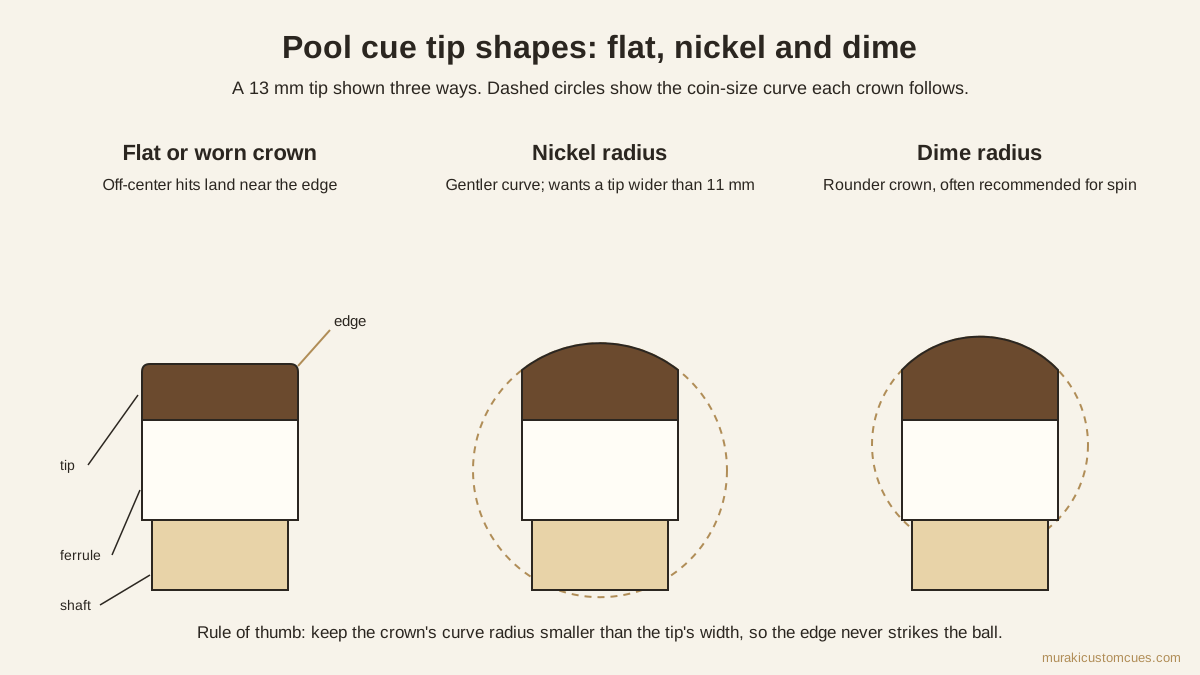
Shape matters more than people expect. A nickel radius is a gentler curve, a dime radius a rounder one. For spin, a rounder crown is often recommended, because the contact point moves out evenly as you move off center. The gap between nickel and dime is tiny, though: well under a millimeter at the contact point even at maximum sidespin. A flat or worn tip is the real problem, since the hit stays in one spot and then jumps to the edge.
A useful rule from Patrick Johnson, quoted on Dr. Dave’s site: shape the crown to a radius smaller than the tip’s width, so you never strike with the edge. He suggests about a quarter radius on a 13 mm tip and a nickel on a 12 mm tip.
When should you shape, scuff or replace a pool cue tip?
There is no fixed schedule. Replace the tip when its shape or feel stops being consistent, whatever its hardness. Between replacements, a few minutes of care keeps it playing the same. More on storage and cleaning is in our pool cue care guide.
- Chalk before every shot.
- Rough up a glazed surface (smooth, shiny, chalk sliding off) with a tip tool so it holds chalk again. Harder tips need this more often.
- Reshape the crown with a shaper when it flattens.
- Trim mushrooming, where the leather bulges wider than the ferrule, taking care not to scratch the ferrule.
- Replace the tip if it chips or cracks.
A centered crown also matters. If the high point of the tip sits off center, you can put sidespin on a ball you meant to hit dead center, which can look like an aiming fault. Our guide on how to aim in pool helps you separate aim errors from equipment ones.

From the bench
A tip is the smallest part of a cue and the part that changes fastest. The forearm and butt sleeve we turn from a solid board picked by hand are meant to last. The leather on the end is meant to be replaced. We sold cues in Vietnam for years, where players in the halls are blunt about a cue’s faults, and the habit stuck: when a hit feels wrong, look at the tip first, because it is the one part built to wear.
So learn what you like on house cues before you commit. Try a medium and a hard tip, chalk properly, and notice the feel and sound rather than chasing spin. When you ask us for a quote, which is free and usually answered the same day, tell us about the cue you play now and we will tell you plainly what we can build around it. A simple place to start is our plain butt cues.
Quick answers
What pool cue tip hardness should a beginner use?
Medium is the usual starting point, and since hardness does not change spin, pick whichever feel you like after trying a few.
Do soft tips give more spin than hard tips?
No. At the same tip offset and cue ball speed, testing summarized by Dr. Dave Alciatore found no spin difference, and a well-chalked hard tip can give as much or slightly more.
How often should you replace a pool cue tip?
There is no fixed interval. Replace it when its shape or feel becomes inconsistent, or when it is glazed beyond repair, badly flattened or mushroomed, chipped or cracked.
What is the maximum tip size for a pool cue?
The WPA’s recommended equipment specifications cap the tip at 14 mm wide, with no minimum, and the tip is fitted to the ferrule of your shaft.
Sources and further reading
- Cue Tip Hardness Effects (Dr. Dave Billiards Info (David Alciatore), Accessed October 20, 2026)
- Cue Tip Size and Shape (Dr. Dave Billiards Info (David Alciatore), Accessed October 20, 2026)
- Recommended Equipment Specifications (World Pool-Billiard Association, 2024)
- How to Choose the Right Pool Cue Tip (PoolDawg, Accessed October 20, 2026)
- The Ultimate Pool Cue Tip Guide (PoolDawg, Accessed October 20, 2026)
How this guide was made: drafted with AI assistance from the sources above and the Muraki workshop’s own build notes, then published by the workshop. Anything about how we build is our own practice; figures from other people are credited. Spot something wrong? Tell us and we will correct it.
Want one built your way?
Tell us the wood, the weight and how you play. One of the four of us answers, usually the same day, with an honest quote. Nothing to pay to ask.


