

The short answer
In the Irish linen vs leather wrap choice, neither one plays better. They change what your back hand feels, not what the cue ball does. Linen is thin and firm, and it is the cheaper of the two to replace. Leather is softer and often a little thicker. No wrap means you hold the finished wood, which is the simplest option and the one most likely to bother very damp hands.
Choose by your hand first. If your hands run very damp, try linen or a soft leather before you order bare wood. If they stay dry, all three work, and the choice comes down to feel and looks. Hold each one before you decide if you can, because experienced players disagree about all of them.
What does a pool cue wrap actually do?
A wrap covers the part of the butt where your back hand sits, usually about 13 to 14 inches long. Its job is grip and comfort. We found no published test showing a wrap changes what the cue ball does. Some retailers say leather dampens vibration and bare wood gives sharper feedback, but they show no data. Treat that as a description of feel, not a fact about the hit.
The wrap normally sits in a shallow channel cut into the butt, so it finishes level with the wood on either side. That small detail explains why swapping materials is not always simple, and we come back to it below.
Balance moves very little. One retailer says leather can shift the balance point back by a fraction of an inch and bare wood can shift it forward. A forum player makes the opposite point: the wrap replaces roughly the same volume of wood, so he doubts it matters much. Nobody we read measured it.
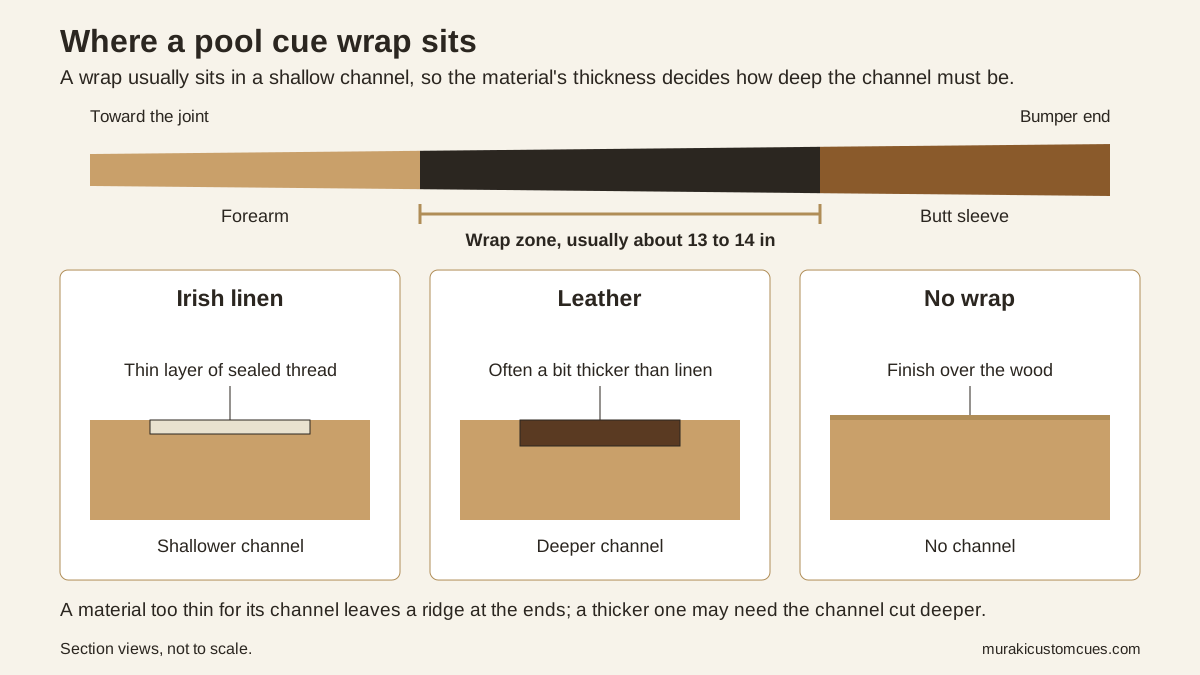
Irish linen vs leather wrap: how do they compare?
This table pulls together what retailers and long-time players report. The cells marked as split are the ones where honest sources disagree.
| Irish linen | Leather | No wrap | |
|---|---|---|---|
| What it is | Woven thread wound tight, then sealed | Usually cowhide or calfskin, smooth or textured | Finished wood, lacquered or oiled |
| Feel | Firm and thin | Softer, conforms slightly to the hand | Smooth and direct |
| Damp hands | Often recommended, but a sealed finish may not absorb much | Split: some say it grips, some say it slips when wet | Split: it can slip, or it can stick |
| Wear | Threads fray with use | Owners report 4 to 10 years or more with no trouble | Nothing to replace; the wood can darken |
| Replacement | About $40 to $80 | A bit more than linen | None |
| Cleaning | Alcohol or mild soapy water on a rag | Dedicated leather cleaner | Wipe it down |
You will see two others. Sport wraps are a soft polymer that is close to waterproof, common on break and jump cues, and they can feel hot over a long match. Nylon is the usual wrap on low-priced cues.
Why do guides contradict each other? One calls linen slippery while another says it grips without feeling sticky. Hands differ, and so do finishes and how worn the wrap is. So far as we can find, nobody publishes test numbers, so a confident ranking is an opinion.
What is the best wrap for sweaty hands?
Linen gets the most votes, but read the fine print. In one AzBilliards thread on sweaty palms, a player recommends linen and calls leather terrible, while another warns that most linen wraps carry a plastic-like finish that will not absorb sweat, so you would want it unfinished.
Bare wood splits people too. In the same thread, one player says a wrapless cue could slip on a firm stroke if the hands are very sweaty, and another found his lacquered butt started sticking to his hand under heat and nerves. Bob Jewett, listed as staff on the forum, wrote that wrapless will not slip even with a fairly loose grip and that leather can turn slippery in dry weather.
So test it instead of trusting a chart:
- Borrow a cue of each type and play a full rack with it, late in a session when your hands are warm.
- If you lean toward leather, ask which hide. In one work glove comparison, deerskin dries soft after getting wet and cowhide does not, while cowhide resists abrasion better. That is glove data, not wrap data, so treat it as a hint.
- Before you pay for a new wrap, try the cheap fixes players suggest: a hand antiperspirant, a towel for the cue, and a looser hold. Our stance and grip guide covers the hold.

How long does a wrap last, and what does re-wrapping cost?
Linen life varies more than the guides admit. In one thread, a player says he replaced the wrap on one cue eight times in 21 years, another has a linen wrap approaching 20 years old, and a third says a modern one should last a lifetime unless abused. Hands, hours and finish all play a part.
For cost, one US retailer puts linen re-wraps at about $40 to $80 from a quality cue maker, with leather a bit more. Add shipping if the shop is not local. Changing linen to leather can cost extra if the channel has to be cut deeper, and a thinner material can leave a ridge at the ends unless the butt is turned down.
Cleaning buys time. Players report good results wiping linen with alcohol on a rag, then drying it. One warns it will freshen a tired wrap but not make it feel new. See our cue care guide for the rest of the cue.
How to choose: a quick checklist
Run through these in order. Your first honest yes is usually the answer. Our guide to choosing a cue covers the decisions that matter more than the wrap, such as weight and length.
- Very damp hands: start with unfinished linen, then try a soft leather. Test bare wood last.
- You like a soft, cushioned hold: leather.
- You like a firm, thin feel: linen.
- Dry hands and you want to see the wood: no wrap.
- Smaller hands: ask for the measured diameter at the grip, since materials differ in thickness and so do butts.
- You keep gripping too tight: fix the hold first. No wrap will do that for you.
From the bench
We do not wrap in Irish linen. Our list is leather in cowhide, deerskin or embossed elephant grain, or no wrap, all at the same price, so money does not have to decide it. If linen is what your hand wants, we are the wrong shop for that part, and we would rather say so now.
A no-wrap butt still has a finish on it. Ours is eight thin coats of lacquer, hand sanded between each, so what you hold is lacquer, not raw wood. It shows the timber well, and the reports above about lacquer turning sticky in heat apply to it too. Our standard butt is 15 oz and a complete cue about 19 oz, and we can go heavier or lighter or shift the balance on request, so tell us your target along with your wrap. It is free to ask, usually answered the same day, on our build your own page.
Quick answers
Irish linen vs leather wrap: which is better on a pool cue?
Neither plays better, since a wrap changes grip and comfort rather than the hit. Linen is thinner, firmer and cheaper to replace, while leather is softer and often slightly thicker.
What is the best pool cue wrap for sweaty hands?
Linen is the most common recommendation, ideally without a heavy sealed finish, but reports on leather and bare wood are split. Try each one with warm hands before you buy.
How much does it cost to re-wrap a pool cue?
One US retailer puts a linen re-wrap at about $40 to $80 from a quality cue maker, with leather costing a bit more. Shipping is extra if the shop is not local.
Does a leather wrap make a pool cue thicker than a linen wrap?
It can, because leather is often a bit thicker than linen, so a shop may cut the channel deeper to keep it level. Players disagree on whether they can feel the difference once it is fitted.
Sources and further reading
- Pool Cue Wraps Explained: Irish Linen, Leather, Sport Wrap, and No Wrap Compared (Quarter King Billiards, 2026-07-18)
- Will switching from Irish Linen to a leather wrap make the grip feel thicker, thinner or the same? (AzBilliards Forums, 2025-07-03)
- For sweaty palms, which cue wrap style? (AzBilliards Forums, 2019-12-05)
- Linen wrap durability and difficulty to change (AzBilliards Forums, 2013-02-08)
- How to Choose the Right Leather Work Gloves For the Job (Wilco Farm Stores, 2022-02-03)
How this guide was made: drafted with AI assistance from the sources above and the Muraki workshop’s own build notes, then published by the workshop. Anything about how we build is our own practice; figures from other people are credited. Spot something wrong? Tell us and we will correct it.
Want one built your way?
Tell us the wood, the weight and how you play. One of the four of us answers, usually the same day, with an honest quote. Nothing to pay to ask.


