

The short answer
To draw the cue ball, chalk well, keep the cue as level as you can, hit well below center, and accelerate smoothly through the ball. Stay down until the cue ball comes back. The cue ball leaves the tip with backspin. If some of that spin is still there when it reaches the object ball, it comes back.
Most draw shots die for one reason: the spin wears off on the cloth before contact. So the fix is often more speed, not a lower hit. Dr. Dave Alciatore’s analysis shows that on long shots, the most draw comes at about 70% to 80% of the way down to the miscue limit, not at the limit itself.
How do you draw the cue ball? Six steps
This order comes mostly from Dr. Dave’s top ten draw tips. Try it on an easy straight shot first.
- Chalk the edges. Hold the cue tip-down and swipe chalk onto the edges of the tip while you turn the cue. Do not grind a hole in the cube. Look at the tip and check it is fully covered.
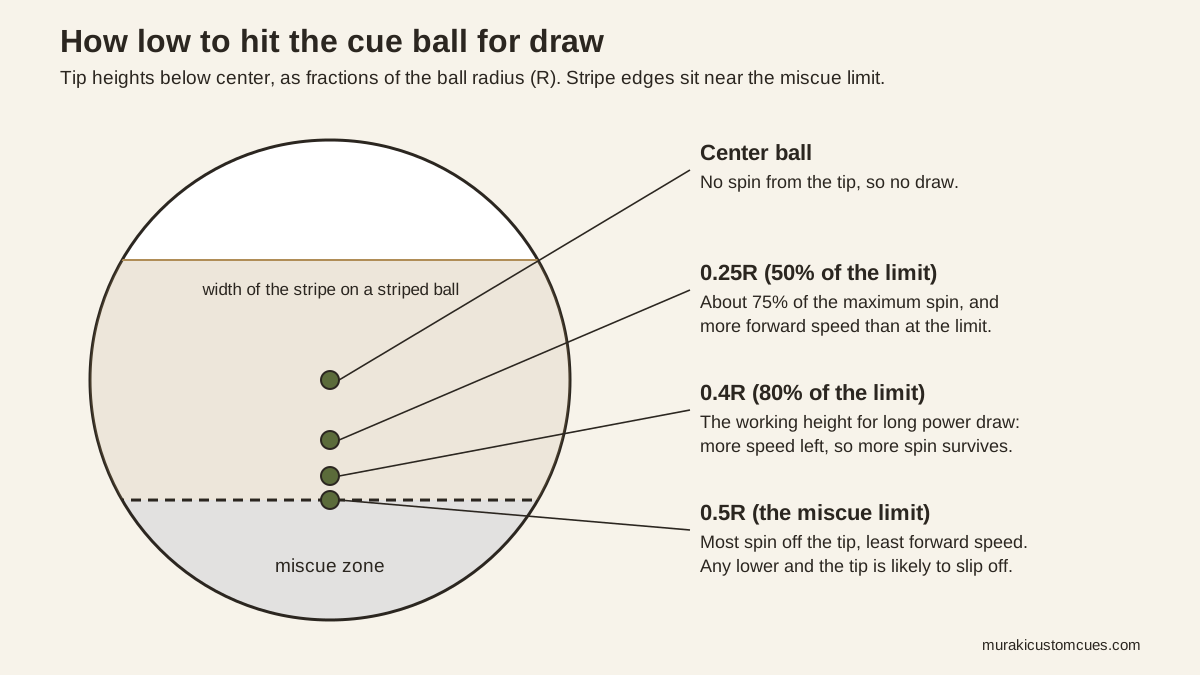
- Pick a height. Use the stripe on a striped ball as your guide. On most balls the stripe edge sits close to the miscue limit, so aim above it.
- Get level. Lower your bridge hand so the cue is as flat as the shot allows. A level cue is more accurate.
- Check, then stroke. Stop the tip at the contact point during your warm-ups and check the height. Keep your eyes on the cue ball for the warm-ups and on the object ball for the last stroke.
- Go back slowly, then accelerate. Keep the grip relaxed. Do not slow down into the ball.
- Finish and stay still. Keep your head, body and elbow still. Stay down until the cue ball returns. The tip should finish down on the cloth.
Instructors differ on bridge length. Corey Bernstein of Quarter King Billiards suggests shortening to 6 to 8 inches. Dr. Dave points out that a longer bridge gives more room to accelerate and helps keep the cue flat. Try both. If your setup feels different every time, start with stance and grip.
How low should you hit the cue ball for draw?
Lower gives more spin, but not at a steady rate. In Dr. Dave’s numbers, going 30% of the way to the miscue limit gives about half the maximum spin, and going 50% gives about 75%. The last part of the trip adds little and costs forward speed.
He measures height as a percentage of the miscue limit, which is half the ball’s radius from center. Advice like “one tip below center” is harder to use, because the distance it means changes with your tip and shaft size. The right height also depends on the shot.
| Shot | Tip height | Speed | Why |
|---|---|---|---|
| Stun-back, 1 to 3 inches | Closer to center | Firmer | Easier to control the small distance |
| Medium draw | Lower | Slower | Better distance control than a faster hit with less offset |
| Long power draw | About 0.4R (80% of the limit) | Hard, but controlled | A faster ball keeps more spin on the way |
| At the limit, 0.5R | Rarely needed | Any | Little extra spin and a real miscue risk |
Why does your draw shot die before it reaches the object ball?
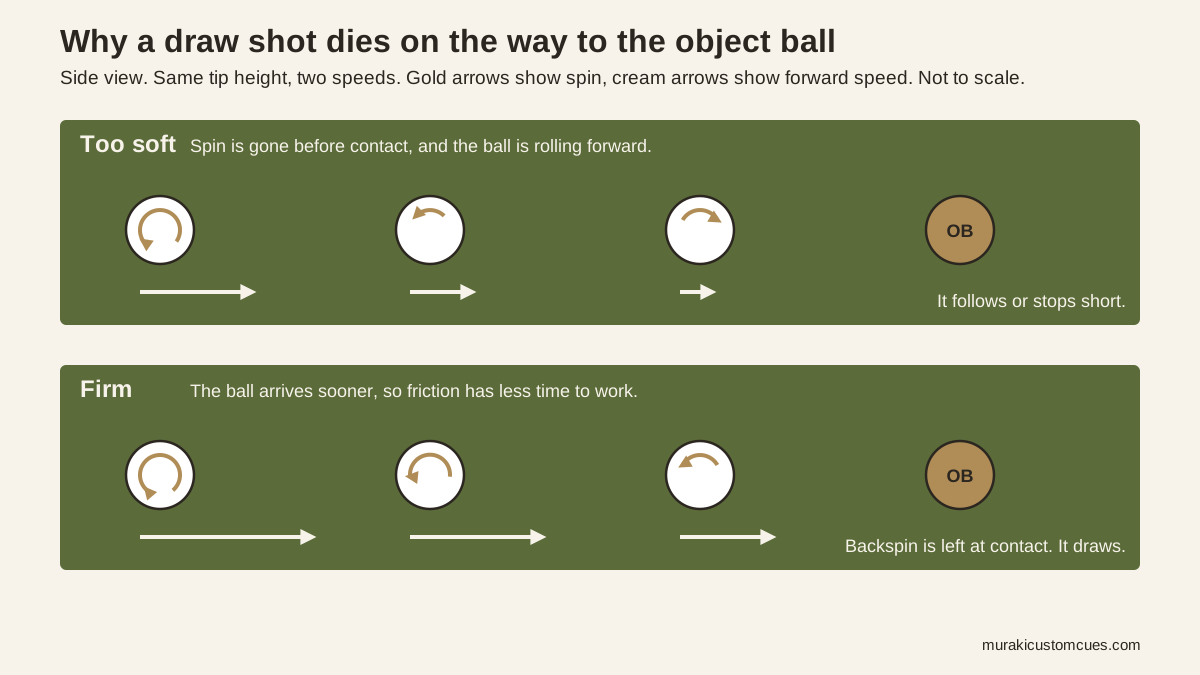
A cue ball hit low does not roll at first. It slides, and the cloth works against it the whole way, taking away both speed and backspin. A slow ball gives friction more time to work, so it loses more spin over the same distance. Hit soft enough from far enough away and all the backspin is gone. The ball then rolls forward into the object ball and follows. Dr. Dave calls that a drag follow.
On a straight shot, draw depends on the spin left at contact, and that is what you are managing. This is why the same stroke draws well from one foot and dies from four.
Cloth matters too. Dr. Dave notes that new, slick cloth makes draw easier, gives longer draw and makes distance easier to control, especially at lower speeds. On a sticky bar table, expect less and allow for it.
Common draw shot mistakes and how to spot them
Watch what the cue ball does, then work back. A slow-motion phone video from the side shows most of these.
| What you see | Likely cause | What to try |
|---|---|---|
| Cue ball stops or rolls forward, clean hit | Spin died on the cloth | Hit firmer before you hit lower, or start closer |
| Tip slips off, cue ball goes astray | Miscue from too low a hit or poor chalk | Aim above the stripe edge and chalk the whole tip |
| Little or no draw from a low aim | Tight arm lifting the cue, or an elbow drop at contact | Relax the grip and film the elbow; it should stay still into the ball |
| Cue ball hops | Butt of the cue raised too far | Lower the bridge hand and flatten the cue |
| Short, weak draw from a big swing | Poke: the cue slows at contact | Accelerate smoothly and finish with the tip on the cloth |
Does the cue matter? Less than most people hope. Dr. Dave’s short answer on cue weight is that it does not matter very much. A lighter cue can help slightly very near the miscue limit on close shots, and a heavier cue can help if you can still swing it fast. A flat or mushroomed tip is worth checking first. The tip guide covers shape and hardness.
A draw drill you can score
This ladder adapts the progressive distance drill from Corey Bernstein at Quarter King Billiards, including his 8 out of 10 test. It trains distance as well as spin.
- Place the object ball one diamond from each rail, straight in to a corner pocket.
- Set two coins beside the line, 1 foot and 2 feet back from the object ball. That is your target zone.
- Put the cue ball on the line, 6 inches from the object ball.
- Shoot 10 shots. A make means the ball is pocketed and the cue ball stops between the coins.
- At 8 of 10, move the cue ball back to 1 foot, then 2 feet, then 3 feet.
- Write down your furthest spot and your score there each session.
If you stall at 3 feet, do not aim lower. Try a firmer stroke at about 80% of the limit, and see whether your score climbs over a few sessions.

From the bench
We build cues, we do not coach. A draw shot comes from the stroke and from practice, and no cue we turn replaces that. Our forearms and butt sleeves are turned from solid boards, and a standard cue weighs about 19 ounces complete. We can build heavier or lighter or shift the balance on request, but given what the physics above says about weight, we would not suggest changing it just to fix your draw.
Where a cue can help is simple. It should feel the same to you every time, so you can trust your stroke and stop thinking about the stick. Players in the Vietnamese halls have been blunt with us about a cue’s faults for years, and that keeps us honest about what wood can and cannot do. If you want to talk through a build, see build your own cue.
Quick answers
How do you draw the cue ball without miscuing?
Chalk the whole tip, keep the cue level, and aim above the miscue limit, which sits close to the stripe edge on most striped balls. For long draw, about 80% of the way to that limit gives as much draw as going lower, with less risk.
Why does my cue ball not come back on a draw shot?
Usually the backspin wore off on the cloth before the cue ball reached the object ball. Hit firmer or shorten the distance before you try hitting lower.
Do you need a hard hit to draw the cue ball?
Not always. Medium draw is easier to control with a slower stroke and a lower hit, but long draw needs real speed so the spin survives the trip.
Does a heavier cue give more draw?
Not by much. Dr. Dave Alciatore says cue weight does not matter very much for draw, and that the right weight depends on the player.
Sources and further reading
- Top 10 Draw Shot Tips (Billiards Digest (Dr. Dave Alciatore), 2020-03)
- Draw Shot Physics, Part I: basics (Billiards Digest (Dr. Dave Alciatore), 2009-04)
- Draw Shot Physics, Part II: examples (Billiards Digest (Dr. Dave Alciatore), 2009-05)
- Draw Shot Cue Weight Effects (Dr. Dave Pool Info, 2024)
- How to Shoot a Draw Shot in Pool: Mastering Backspin for Better Position (Quarter King Billiards (Corey Bernstein), 2026-07)
How this guide was made: drafted with AI assistance from the sources above and the Muraki workshop’s own build notes, then published by the workshop. Anything about how we build is our own practice; figures from other people are credited. Spot something wrong? Tell us and we will correct it.
Want one built your way?
Tell us the wood, the weight and how you play. One of the four of us answers, usually the same day, with an honest quote. Nothing to pay to ask.


